Final GPS III satellite launch & Roman telescope assembly completed - Space News (Apr 21, 2026)
Final GPS III satellite launch & Roman telescope assembly completed - Space News (Apr 21, 2026)
Our Sponsors
Today's Space News Topics
-
Final GPS III satellite launch
— The U.S. Space Force and Lockheed Martin completed the GPS III constellation with the launch of SV10 on a SpaceX Falcon 9, boosting accuracy, resilience, and anti-jam performance for global navigation and timing. The mission also showcased reusability and introduced advanced demonstrations like optical crosslinks and an upgraded atomic clock. -
Roman telescope assembly completed
— NASA finished assembly of the Nancy Grace Roman Space Telescope and began prelaunch testing, moving a flagship observatory into its final readiness phase. Roman’s wide-field sky surveys and next-generation exoplanet imaging technology aim to transform research on dark energy, galaxy evolution, and planetary systems. -
New Glenn reuse, payload anomaly
— Blue Origin’s New Glenn achieved a key reusability milestone by re-flying a first-stage booster, but a payload insertion issue left the BlueBird 7 satellite in an unusable off-nominal orbit. The incident triggered an investigation, highlighting the difficulty of precision orbital delivery even as reusable launch systems mature. -
Artemis II crewed lunar flyby
— Artemis II completed a 10-day crewed lunar flyby mission and safely splashed down, setting a new human distance record beyond Apollo 13’s mark. The flight validated Orion and SLS for deep-space crew operations and underscored international cooperation with Canada’s participation. -
April skies: Lyrids, planets, asteroid
— Late April 2026 offers prime observing highlights including the Lyrid meteor shower peak, bright evening Venus guiding observers toward Uranus, and close planetary groupings in the morning sky. A small near-Earth asteroid also made a safe close approach, reflecting ongoing progress in detection and tracking.
Full Episode Transcript: Final GPS III satellite launch & Roman telescope assembly completed
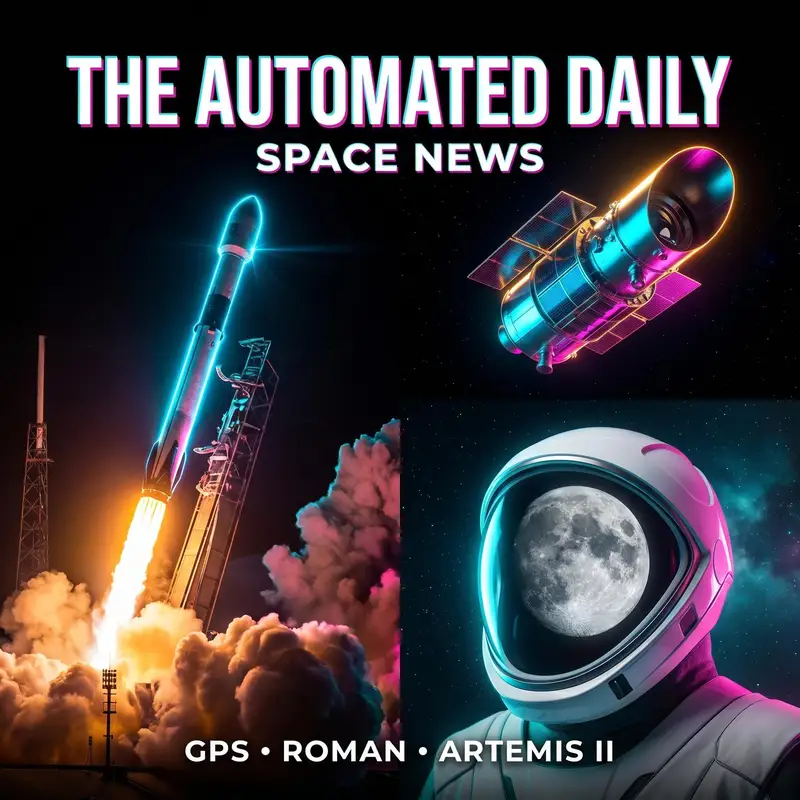
Welcome to The Automated Daily, space news edition. The podcast created by generative AI. Today we’re tracking a major navigation milestone as the final GPS III satellite reaches orbit, a flagship NASA telescope that’s moved from assembly into prelaunch testing, and a mixed result for a reusable heavy-lift rocket—plus a quick tour of late-April skywatching and recent human spaceflight highlights.
Final GPS III satellite launch
The United States Space Force has completed deployment of the GPS III constellation with the launch of GPS III Space Vehicle 10, also designated SV10. The satellite lifted off April 21, 2026 at 2:53 a.m. Eastern on a SpaceX Falcon 9 from Cape Canaveral Space Force Station. SV10—named “Hedy Lamar” in recognition of Hedy Lamarr’s frequency-hopping work—carries demonstrations that point to a more resilient navigation architecture, including an optical crosslink payload for satellite-to-satellite communication and a Digital Rubidium Atomic Frequency Standard clock for highly precise timing. The mission also underscored operational reusability: the Falcon 9 booster flew for the seventh time, and the fairings were re-flown as well. After about ten days of orbit-raising and a short on-orbit checkout, the satellite is expected to transition to operational control, while the program shifts toward the next GPS IIIF production run.
Roman telescope assembly completed
NASA marked a major observatory milestone on April 21, 2026, announcing that assembly of the Nancy Grace Roman Space Telescope is complete and the mission has entered prelaunch testing. Roman is designed to deliver panoramic, high-sensitivity views of the universe, enabling wide-field surveys of distant galaxies and new constraints on dark energy, while also advancing exoplanet science. A standout feature is technology intended to demonstrate the most advanced space-based capability yet for directly imaging planets around nearby stars, a step toward future life-search missions. With the spacecraft now integrated, engineers will move through comprehensive functional and environmental testing to verify performance across subsystems before NASA finalizes launch timing.
New Glenn reuse, payload anomaly
Blue Origin’s New Glenn notched an important reusability achievement on April 19, 2026, completing its third orbital flight and reusing a first-stage booster for the first time. The booster, previously flown on the NG-2 mission and outfitted with new engines, separated roughly three and a half minutes after liftoff and landed on the droneship Jacklyn in the Atlantic. But the mission’s primary payload, AST SpaceMobile’s BlueBird 7 direct-to-cell satellite, was later reported to be in an off-nominal, lower-than-planned orbit—too low to sustain operations with its onboard thrusters—leading to a decision to de-orbit the spacecraft. The loss is expected to be mitigated by insurance, and the anomaly prompted New Glenn launches to be paused pending investigation, reinforcing that upper-stage performance and precise orbital insertion remain among the hardest parts of launch execution.
Artemis II crewed lunar flyby
In human spaceflight, Artemis II concluded with a splashdown on April 10, 2026 after a 10-day crewed mission that included a lunar flyby. The crew—NASA astronauts Reid Wiseman, Victor Glover, and Christina Koch, joined by Canadian Space Agency astronaut Jeremy Hansen—reached a maximum distance of 252,756 miles from Earth, surpassing Apollo 13’s record by about 4,111 miles. After the flyby on April 6 and departure from the Moon’s sphere of influence on April 7, Orion returned for a Pacific Ocean recovery off California, with the crew safely retrieved by the U.S. Navy. The mission provided a major confidence boost for Orion and the Space Launch System ahead of future Artemis flights aimed at building a sustained lunar presence with international partners.
April skies: Lyrids, planets, asteroid
For skywatchers, late April 2026 brings multiple highlights. The Lyrid meteor shower peaks around April 22 to 23, typically producing about twenty meteors per hour, and this year’s viewing is helped by the Moon setting around 2 a.m. local time, leaving darker skies before dawn when the radiant is higher. Planetary viewing remains strong too: Venus dominates the evening sky and can help guide binocular observers to faint Uranus around their late-April conjunction, while Jupiter continues to showcase the Galilean moons in modest telescopes. In the morning sky, Mars, Mercury, and Saturn appear in a relatively compact grouping. And on the planetary-defense front, a small near-Earth asteroid, 2026 HJ—only a few meters across—passed safely at about 251,000 kilometers on April 19 at 19:13 UTC, an example of routine close-approach monitoring that now happens with increasing reliability.
That’s it for today’s space news edition. If you enjoyed this roundup, check back for more updates on Roman’s march toward launch, commercial heavy-lift investigations, and the next milestones on the road back to the Moon.
More from Space News
- October 9, 2026 Record-breaking radio flash from early universe
- October 8, 2026 Vampire star devours brown dwarf & Einstein Probe reveals neutron phase
- October 7, 2026 Crew-12 Heads Home From ISS & South Korea's Nuri Launches NEONSAT
- October 6, 2026 First exoplanet radio signal detected & Solar eruption may supercharge auroras
- October 5, 2026 X-Rays Reveal Heat Shields Burning & Surprising Soft X-Ray Merger Glow